
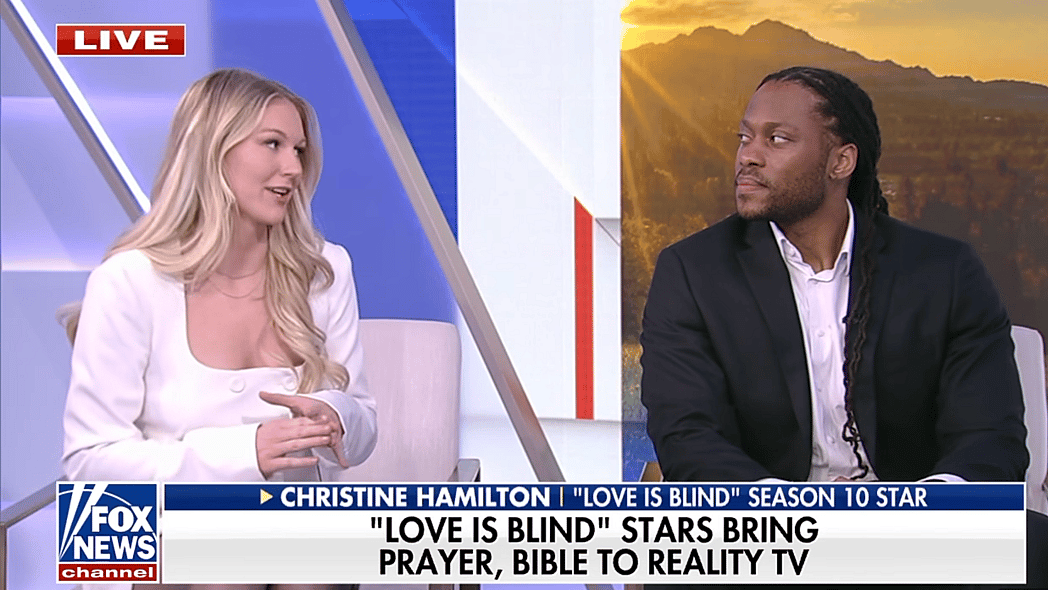
After stealing the hearts and sympathies of “Love Is Blind” fans, even as Netflix appeared to pull away from their storyline, season 10 stars Vic St. John and Christine Hamilton seemed poised to be remembered as one of the franchise’s rare “good couples.”
But following recent appearances on Fox News and Fox News Digital in which the couple spoke openly about their Christian faith and credited God, not the producers, for bringing them together, the discourse around them has shifted. Instead of celebrating their union, fans are debating what their appearance may reveal about their couple’s ideologies.
“I am a firm believer that faith shouldn’t be forced. It isn’t forced on me—we have free will,” the 34-year-old college professor wrote Wednesday, March 25, in a post on Threads as backlash mounted.
“I also believe that God’s love is for anyone regardless of nation, politics, race, etc. It’s available to anyone who wants that life (or not),” he continued. “In times where faith is weaponized (used to oppress & harm), it’s important to share what faith means to me—regardless if it’s on Fox, CNN, or the street. When asked to share my faith, there’s a good chance I’ll say yes. Always open for this dialogue.”
View on Threads
Since posting, St. John has engaged in nuanced debates with followers in his replies, with some questioning whether appearing on a network frequently criticized for promoting right-wing political narratives was appropriate, even if his intention was simply to share his faith. The moment and the sudden closer scrutiny of who both St. John and Hamilton appear to be after filming has also left some fans second-guessing the season altogether and whether they just watched the franchise lean hard into the right.
This season, set in Ohio, followed the show’s familiar format where singles meet sight unseen through a wall while sequestered in pods. They go on a series of “dates” in the pods where one can imagine all sorts of topics come up, ranging from upbringing, career, hopes, fears, religion, and of course, politics. But many viewers noticed the deeper ideological conversations that had defined some previous seasons were missing. Several contestants have since confirmed that political discussions they recall having didn’t make the final cut.
Contestants Jess Barrett and Keya Kellum have both said on recent podcast appearances they asked dates directly about their political beliefs. Barrett described politics as a major pillar of her life, while Kellum revealed that she made a point of discussing voting choices with potential partners.
Kellum said on the “What’s the Reality?” podcast in February that she asked all of her pod dates about their political leanings, hoping they would say they did not vote for Donald Trump.
“Not everything makes the cut, but something I stood really firmly on was my political beliefs,” she said. “And I had a ton of conversations about that in the pods with men who had opposing beliefs. The framing that it is Republican against Democrat is just so not true. It is all of us against hate. And what I do not stand for is hate.”
Barrett shared a similar experience on the “Love to See It” podcast, saying, “I specifically asked everyone, ‘Did you vote for Trump? Are you a Trump supporter?’ And I talked ad nauseam about human rights because that is such a pillar of my life.”
What did make it to air, however, included at least one explicitly pro-Trump moment. When Ashley Carpenter introduced her fiancé, Alex Henderson, to her parents, one of the first questions her father asked was who Henderson voted for. Henderson said he did not vote because he was out of the country, but added that he would have supported Trump.
With fewer political conversations shown overall, one visible pro-Trump exchange, and the season’s most stable couple appearing on Fox News — in what appears to be a first for a “Love Is Blind” couple — some viewers are left wondering what story the season was trying to tell.
The situation has also placed St. John, a Black public policy professor, in the middle of a complicated cultural debate. He has maintained that his appearance was solely about sharing his faith. Still, some fans question how that decision intersects with the political realities associated with the platform.
The whole ordeal also highlights a deeper tension that has always existed within “Love Is Blind.” While the show presents itself as a social experiment about whether love can transcend appearance, it is still ultimately a produced television show where what audiences see is shaped as much by editing choices as by reality itself. And that may be the real issue fans are grappling with now. If politics were discussed but largely left on the cutting room floor, viewers are now left trying to piece together the full picture from interviews and social media debates happening after the fact. In a season where contestants say ideology mattered deeply in their dating decisions, the absence of those conversations on screen may say just as much as anything that aired.
Whether intentional or not, it raises a bigger question about the responsibility of reality dating shows to reflect the real conversations people are actually having about values and identity in an increasingly polarized country. Because if love isn’t happening in a vacuum, the experiment shouldn’t be edited like it does.
