
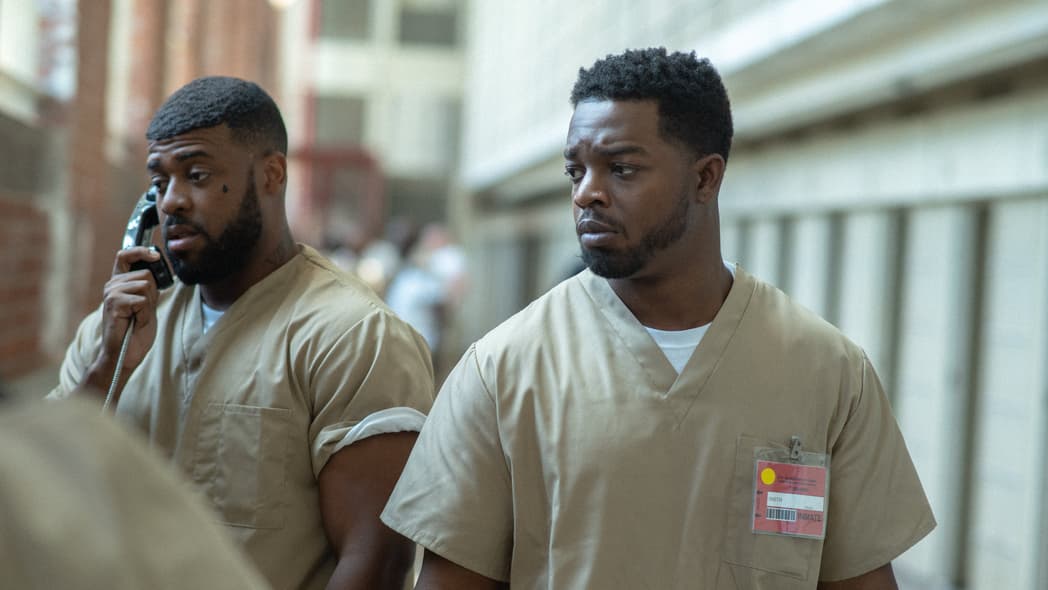
Before you write off “Ricky” as another film about the criminal justice system, here’s what director and writer Rashaad Frett needs you to understand: 90-something percent of it doesn’t even take place in prison. The film, starring Stephan James and Sheryl Lee Ralph and co-written by Frett and Lin Que Ayong, is less about what happens behind bars and far more about what happens when a man who’s been gone for 15 years has to find his way back to a world that moved on without him. It’s a story about second chances. And depending on how honest you’re willing to be with yourself, you may see yourself in the story, too.
“This almost could have happened to anybody,” James told theGrio. “Ricky wasn’t some degenerate kid. He made a mistake, and that mistake changed the course of his whole life.”
That’s the point James, 32, was most determined to make. When preparing for the role, the “If Beale Street Could Talk” actor wanted to understand two things simultaneously: the innocence of a 15-year-old who doesn’t yet know what’s at stake, and the psychological weight of a man who’s spent the better part of his life inside a system not designed to heal him.
“I really wanted to dive back into the mind of a 15-year-old young man,” he explained, “to understand where they were in life, what’s being taken away from them when they enter into a system like this.” As a result, Ricky’s humanity becomes the film’s most pivotal element.
“We’ve all been guilty of those things at one point or another in our lives, usually earlier in our lives,” James says of the kind of youthful mistakes that can spiral into life-altering consequences depending on your zip code, your resources, and frankly, your luck. “I wanted to make that very clear. I wanted to make him relatable in that way.”
Frett, who has spent years studying the lives of incarcerated and formerly incarcerated people, made a point to cast real inmates in the film, a decision that became one of the most formative parts of the entire production. For James the experience of watching an “an inmate pretending to be an actor” while being an “actor pretending to be an inmate” made the project even more meaningful.
“I found myself laughing with them, joking with them, wanting to cry with them,” he recalled, ultimately serving as a reminder that “there’s a whole person behind the cell that I really wanted to give people a chance to see through Ricky.”
That insistence on full humanity extends to everyone the film touches. “This story centers around Ricky, but it really is about how that incarceration affected all the people,” Ayoung shared in an interview with theGrio. “The parents do time. Families do time. The loved ones, the friends; everybody’s doing time. it was important that we saw how much of a village people need.”
“It really transcends prison. Any one of us can grow up with trauma that stunts our growth in some way, shape, or form. And it does take a village to bring us back, to heal, to get to the point that we need to be,” she continued. “It was important that we showed the different perspectives surrounding recidivism, that it’s not just about the person you know who is going through this.”
For Frett, who has seen the impacts of recidivism in his personal and professional life, working on documentaries, “Ricky” spotlights the void communities often miss.
“One of the many questions that I hope that this film [sparks] is, ‘how can we support ex-offenders more when they come out,’” the director shared. “I knew people, friends, family members, been in and out of the criminal justice system. I knew people that worked in programs that helped ex offenders outside of the prison, and what was brought to my attention is that the actual transition from going in to going out, there’s like a void of that transition, and there needs to be more support.”
While discussing the transition, Frett draws a striking parallel to ancient warrior cultures like the Maasai of East Africa, who built healing and cleansing rituals for warriors returning from the battlefield to combat trauma.
“When you come from a very intense environment and you’re adjusting back to being around civilization,” Frett explained, “there’s a huge disconnect. Some people can’t snap back.”
Echoing the conversation about recidivism and “How could we create better systems within the system to be conducive to rehabilitation, James also notes that the film spotlights the important conversations surrounding mental health. But the conversation Ayong seems most invested in is the one about what we owe each other.
“’Ricky’ is about second chances,” she shares. “I feel like all our growth is stunted in some way, shape, or form. And I’m talking about our [Black] community, but in so many other people’s communities. Our growth is stunted, and we all have these preconceived ideas about other people, whatever that other is, and we go around in life, living by these stereotypes, but if we give people a chance, we may actually learn something…like we’re all we all we have like commonalities.”
That, ultimately, is what “Ricky” is asking of its audience. “Ricky” isn’t asking you to fix the prison industrial complex by the time you leave theaters. It’s asking something smaller but equally impactful: to sit with the version of yourself that didn’t know better yet and extend that same mercy and grace outward.
See “Ricky” in theaters on April 24.
