
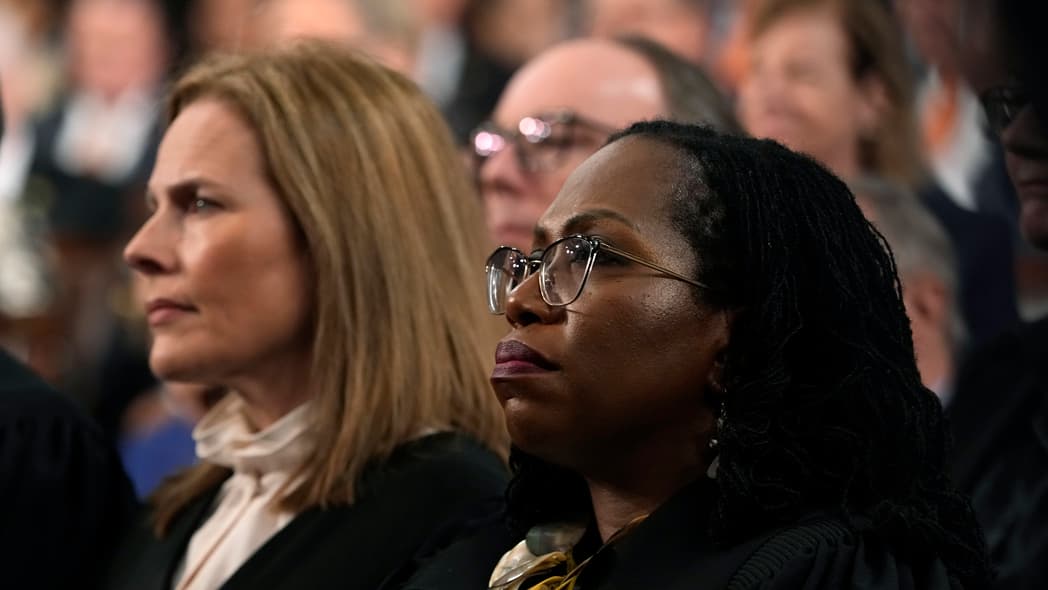
Justice Ketanji Brown Jackson is continuing to scold her conservative colleagues on the U.S. Supreme Court. Following the high court’s gutting of the Voting Rights Act of 1965 in Louisiana v. Callais, nearly a week later, the conservative majority made a ruling that sets the path for the state to halt its primary election — which is already underway — to redraw its map and eliminate a second majority-Black district that the court shockingly ruled unconstitutional.
The latest SCOTUS order, issued on Monday evening, speeds up the normal 32-day timeline before the justices formally return a case to the lower court.
Justice Jackson, the first Black woman to serve on the nation’s highest court and the most junior member of the bench, did not mince her words when calling out the judicial ruling and what she described as the potential for partiality in an ongoing political issue sparked by President Donald Trump.
“To avoid the appearance of partiality here, we could, as per usual, opt to stay on the sidelines and take no position by applying our default procedures,” Jackson wrote in her four-page dissent. “But, today, the Court chooses the opposite. Not content to have decided the law, it now takes steps to influence its implementation.”
Less than 24 hours after the Supreme Court ruled on April 29 that Section 2 of the Voting Rights Act does not require Louisiana to have two majority-Black districts despite African Americans making up more than 32% of the state’s population, Governor Jeff Landry indicated that he would call an emergency to suspend the state’s primary elections already underway in order to redraw the congressional map.
The move seeks to give Republicans a political advantage, as states across the country are engaging in gerrymandering following Trump’s 2025 call for Texas to defy tradition and redraw its map to give his party at least five additional seats in the U.S. House of Representatives. As the president faces tanking approval ratings, most notably on the economy and his signature policy issue of immigration, the gerrymandering fight is his last-ditch effort to keep control of Congress in 2027. Trump has warned that if Democrats win the majority, he will be impeached.
“The question whether our decision should affect the map to be used in the ongoing primaries raises a host of legal and political questions that are entirely independent of the issue in Callais,” writes Justice Jackson, who pointed to prior decisions by the court that Monday’s ruling seemingly defies.
“Courts should not risk assuming political . . . responsibility for a [partisan map-drawing] process that often produces ill will and distrust,” says the former U.S. District and Court of Appeals judge. “There is also the so-called Purcell principle, which we invoked only five months ago to chide a federal district court for ‘improperly insert[ing] itself into an active primary campaign.'”
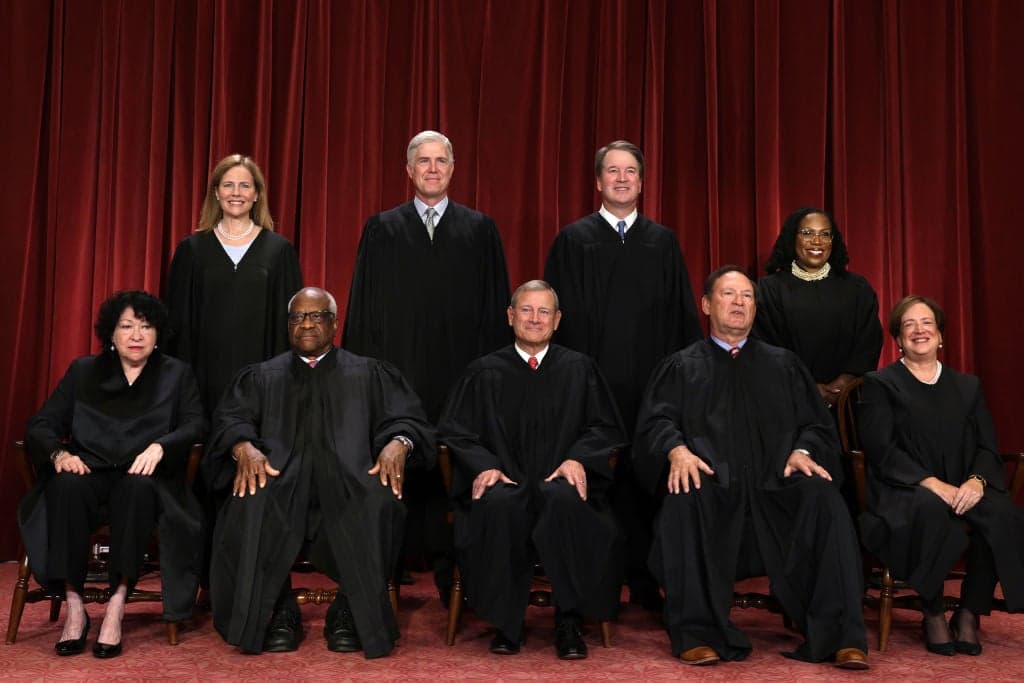
At the heart of the Louisiana v. Callais issue, for voting rights and civil rights leaders, is the ability for Black voters, who make up 13% of the population and faced nearly a century of racial discrimination in voting—as well as racial violence and terror—to have equal representation under the law by being able to elect candidates of their choice. However, in Callais, the court essentially said that diluting the power of Black voters is permissible for political reasons. Any plaintiff challenging an election map under the VRA, they ruled, would have to prove that the slicing and dicing of Black or brown communities in redistricting was intentionally based on race.
Jackson, who dissented in the Louisiana case, does not call out the merits of the case in Monday’s ruling, sending the case back to the lower court, but notes the political activities around efforts to expedite its ruling to rush through a new map as problematic for the Supreme Court.
“These post-Callais developments have a strong political undercurrent. Louisiana’s hurried response to the Callais decision unfolds in the midst of an ongoing statewide election, against the backdrop of a pitched redistricting battle among state governments that appear to be acting as proxies for their favored political parties,” said Jackson. “And as always, the Court has a choice.”
The Harvard Law-educated justice noted that SCOTUS has only broken its 32-day timeline to return a case only twice in the last 25 years.
“The Court’s decision to buck our usual practice under Rule 45.3 and issue the judgment forthwith is tantamount to an approval of Louisiana’s rush to pause the ongoing election in order to pass a new map,” noted Jackson.
She added, “The Court unshackles itself from both constraints today and dives into the fray. And just like that, those principles give way to power. Because this abandon is unwarranted and unwise, respectfully, I dissent.”
Monday’s blunt dissent comes weeks after Jackson gave a rare rebuke of her colleagues during a lecture at Yale Law School. She called out the conservative majority for its unusually frequent rulings in favor of President Trump’s emergency docket requests, allowing his administration to carry out many of its policies before they are fully litigated in court — some of which she noted could be illegal.
“Are we going to allow him to do this thing, this thing that is being challenged in the interim, while we are evaluating whether or not that thing is lawful?” Jackson queried. “The only way to make that determination without having it just completely collapse into forecasting the merits is to focus on what is going to happen if he does this thing concretely in the real world, versus not.”
Tiffany Royster, Esq., associate counsel at the National Council of Negro Women, notes that Jackson’s vote in the Supreme Court is “for the most part, overwritten every time.”
“Her dissents are obviously in the minority, and just thinking about the 6-3 makeup of the court, the majority is getting to decide how these cases are decided, and they necessarily don’t share her perspective on the issues,” Royster tells theGrio. “She really does have very little formal power, the 6-3 makeup, but she’s using her voice and using her voice in a way where she’s not staying silent.”
