
The Black Census Project, a periodic mass-scale survey capturing the opinions of Black Americans to drive better policy outcomes, is taking on a new meaning as Black communities grapple with the rollback of voting rights, high unemployment, and the threat of widening racial disparities amid an anti-DEI political movement.
This year’s survey, conducted by Black Futures Lab, seeks to understand the vision Black communities have for themselves, even when present-day circumstances make them seem out of reach.
“We’re actually using the Black Census Project to gather information from Black voters about what their vision is for the future and what dreams they have for what the government should be doing, what power should be looking like in our communities, because we know that what we have right now isn’t working,” Alexsis Rodgers, Managing Director of Strategy and Impact at Black Futures Lab, told theGrio.
In previous years, Black voters were polled about the “problems” they faced. Rodgers said insights from those surveys were used to “develop policy solutions that Black organizers across the country have been using to try to move the needle in their cities and states.” However, she told theGrio, “We just knew, with all the attacks on our communities this year and in this moment, we had to do something different. As a result, the survey questions are more so “forward looking” and “rooted in Black dreams.”
The Black Census Project was first launched in 2018 under the leadership of Alicia Garza, a co-founder of Black Lives Matter. At that time, the survey collected 30,000 responses from Black voters. The results were used to develop a list of policy recommendations for the first 100 days of President Joe Biden’s administration in 2021.
The second survey, conducted in 2022 and 2023, grew to 200,000 responses and captured Black Americans’ sentiments on economic issues such as the cost of living, health care, and housing. That led Black Futures Lab to create a comprehensive policy agenda on economic issues, which it called the Black Economic Agenda. As a result of the Black Census policy recommendations, Black Futures Lab launched a housing campaign in Georgia and established participatory budgeting in Milwaukee. Years later, when Kamala Harris became the 2024 Democratic presidential nominee, the then-U.S. vice president released an economic opportunity plan that addressed housing policies highlighted by advocates based on data collected by the Black Census Project.
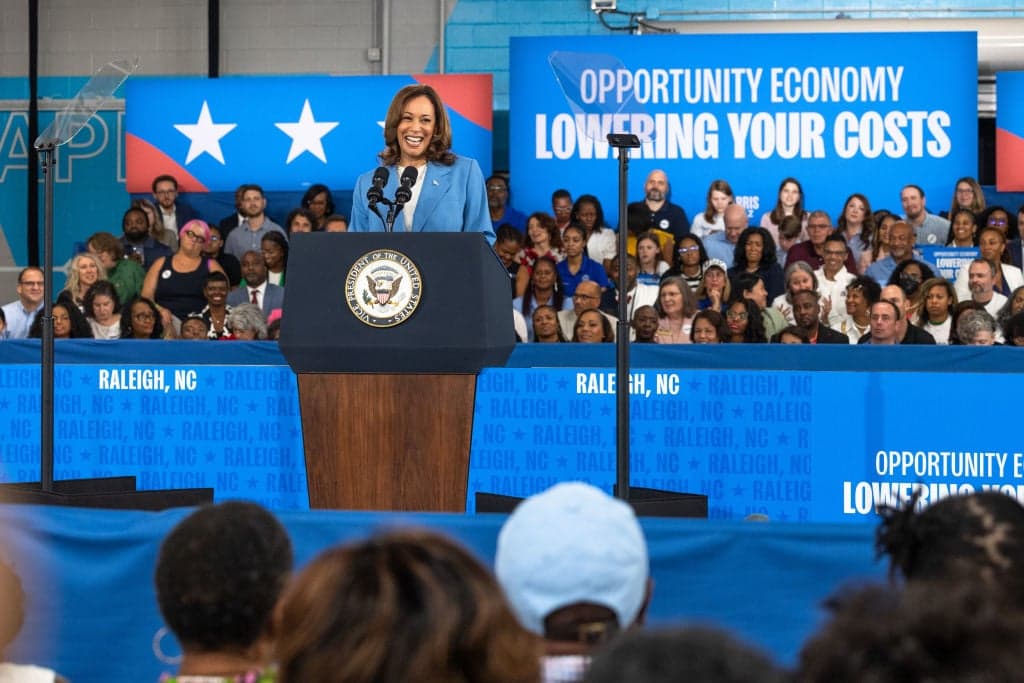
“A lot of the things that we named, in terms of rezoning communities, making sure that we’re having more homes built right…saw a more robust housing policy platform, I would say that presidential campaigns have released in my lifetime,” said Rodgers. “We know that there is power in collecting Black data at scale, and then using that to inform our policy making, using it to push candidates and elected officials to act in our interests.”
This year’s survey goal is to reach 300,000 Black Americans. Its future-focused theme examines how the government can be reshaped to address the needs of Black communities. The survey explores issues such as whether the two-party system needs to change, the role and makeup of the Supreme Court, and whether the Electoral College should be reformed to a national popular vote.
Rodgers acknowledges that, as Black communities face multiple crises today, it may be difficult for them to take a survey that calls for them to think about their future when they are staring down political or economic strife in the present moment.
“We’re under so much attack that it’s robbing us of the space and the freedom to dream and the right to dream, and that is actually a tool of fascism and authoritarianism to keep us so underwater, so under siege, that we can’t stand up, much less fight back or dream,” she told theGrio. “Now is absolutely the time to build new and to build better than we’ve ever been before, and Black people have to be at the center.”
More importantly, Black Futures Lab hopes that the data they collect can be harnessed and placed into the hands of political candidates, in local, state, and federal governments, so that they can seriously take the “demands of Black voters seriously.” That is especially so for the 2028 presidential election.
“Even though that’s two years away, I know that I want to see presidential candidates that are speaking to the unique interests and needs of our community,” said Rodgers. “We need to have candidates at every level of government taking the demands of Black voters seriously, and we hope that the Black Census Project will provide that.”
The advocacy leader pointed to the meteoric rise of New York City Mayor Zohran Mamdani, who ran on economic issues that he sourced directly from residents, most especially Black New Yorkers who faced decades-long racial discrimination.
“If you cast a bold vision, people will show up in a way that you wouldn’t imagine — instead of these limited visions — that are both practical and possible,” she told theGrio. “We’re seeing change when people have a vision that they’re actually inspired by.”
You can take the 2026 Black Census Survey here.
