
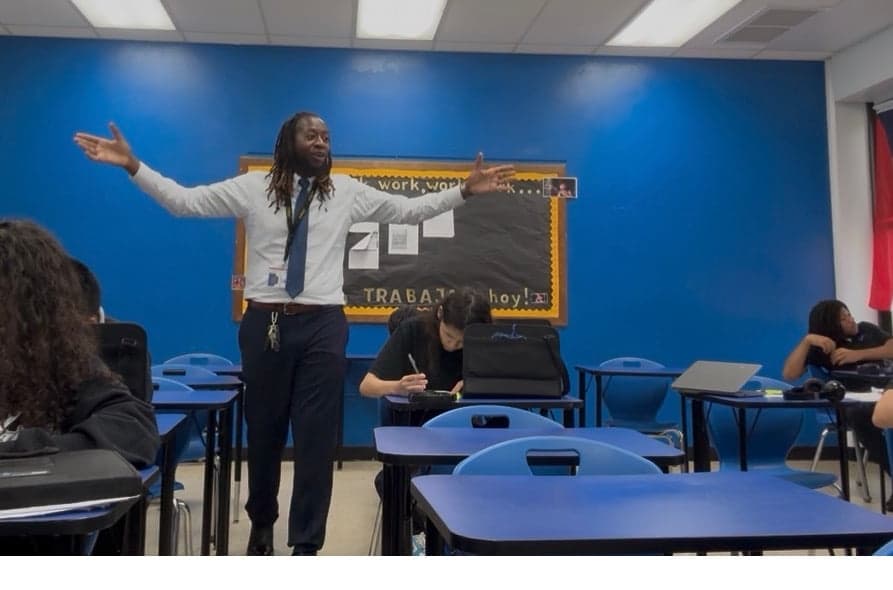
“When did you have your first Black male teacher?”
The question pops up on social media ever so often as a glimpse into what is a known rarity in education. During the 2020-2021 school year, Black male educators made up fewer than 2% of the 3.8 million educators in the country. While the numbers have improved since that eye-popping statistic, they still pale in comparison to a similar study that found more than 6% of Black men were educators three years prior.
It’s something that frequently pops into Khary Golden’s mind.
Even as Leon Smith, a Black man, was honored as the 2026 National Teacher of the Year, the Camden, New Jersey, native can recall his first Black male teacher in the sixth grade. Their interactions, both in and out of the classroom, shaped his mindset for the future. Now Golden is giving back as a Black male educator through Teach For America, an organization that has, in recent years, expanded its outreach to attract young Black male educators.
According to a representative for the organization, nearly one-third of its teaching corps are Black educators, and over half of its corps, at a figure above 58%, are people of color, nearly 40 percentage points higher than the national average.
Golden’s thoughts bleed into his daily classroom work. He tells his students he loves them every day. He understands his words are powerful, and even before entering the classroom, he focused on preparing future teachers to enter the workforce, all in the aim of increasing the number of Black men in the classroom.
“I’ve dedicated a good portion of my life to that,” Golden told theGrio. “My role prior to going on this journey as a first-year teacher was serving as an executive director of a teacher pathway, a teacher certification program. I got the opportunity to speak and lobby and advocate at some of the highest levels in the state of New Jersey for more homegrown educators.”
He continued, “I believe that we are totally missing the forest for the trees, there are so many talented Black and brown educators that are already working in public schools and in charter schools in inner cities that with a little bit of support to finish a degree, a little bit of financial support to go through the certification process, we could already be solving this teacher shortage issue.”
Golden, a father of three, echoes the thoughts of Zahkee Williams, another Black male educator with Teach For America who took a non-linear path to education, even as he applied teaching concepts to one of his primary loves: filmmaking.
“I was working on this project in high school and it kind of connected everything,” the 23-year-old Philadelphia native says. “One of the intentions behind this play was to show the administration at my school some of the things that the students were feeling.”
In Williams’ eyes, the piece was supposed to bridge a gap between both students and administration. Serving as the director for his friends put him in a creative zone.
“I felt in my element being in this position of trying to help people go toward this goal.”
Building The Next Generation
Williams, a graduate of the University of Richmond, shares Golden’s outlook on teaching and empowering youth. In college, the idea of studying to become a teacher never crossed his mind. Just filmmaking. He left school with degrees in film and leadership studies, but understood the shared responsibility that a good director has with a good educator. If every person working in a scene is operating at the best of their abilities, magic can happen.
It’s something TFA recognizes as well.
“A recent Deloitte survey shows that nine in ten young people say purpose is essential to their job satisfaction and overall well-being at work,” a representative for the organization says. “At Teach For America, that sense of purpose shows up through meaningful responsibility from day one.”
The process has shown up in TFA’s recruitment, frequently visiting Historically Black Colleges and Universities, launching programs aimed at educating Gen Z, and a tutoring program that pairs college students with small groups of students. The latter is fostering a pipeline for more young educators in the country.
TFA believes its mission is tied to proximity and community. Studies have shown that dropout rates for high school students who have a single interaction with a Black male educator decrease by 39% while their aspirations to go to college increase by 19%. Another study reveals the impact of having a Black teacher during the formative years between third and fifth grade. The graduation rate among Black students increased by 33% when they had a Black teacher during that period.
Lessons From Home
As a youth, he recalled the impact Black teachers had on him in Philadelphia, particularly at Central High School, which he called the “best” school in the city. But it took someone speaking life into him to help guide him down his desired path.
“I had a black Spanish teacher named Mr. Johnson at Central,” Williams says. “During my sophomore year, I was in his classroom during homeroom. And having that space of community, of being able to kind of whatever I was going through, having this place of like, this is a teacher that I know I’m cool with, that I know I can chop it up with, and also just be able to chop it up with my friends? That was very important.”
Golden has a similar story.
“Mr. Ward, he was the first brother I saw in a lab coat,” he explains with a laugh. “It was one of the most challenging classes that I’ve had up to that point. But also, he took an interest in me outside of class. He’d speak life into me, and he’d even ask me if I ever considered being a teacher. At the time, I didn’t. Now, when I look back? It’s one of those moments where it all crystallized.”
Growing up in Camden, Golden understood his community of tight-knit people, despite poverty raising a constant omen. Fearful that the school system would eat him alive and discard him like so many Black boys in the area, his mother moved him out of the city in the seventh grade. His worldview shifted with the move, placing him in a world that wasn’t primarily Black, but one where he was a minority surrounded by affluence. It prompted him to find community once he graduated, and he discovered it at Morehouse College in Atlanta, Ga. Still, the burning desire to return to Camden gnawed at him.
So he decided to do something about it.
“Education in my path as a lifelong learner to becoming an educator has been shaped in classrooms,” he says. “And you know, the impact that I seek to have is a result of the impact that people have had on my life.”
He adds, “What better candidates could we have to serve in these classrooms and the people who are already working in these schools, and I’m talking about paraprofessionals, long-term substitutes, some of the other staff that work in school. So I had a chance to fight this good fight, but once again, this opportunity was my chance of walking like I talk it.”
For both men, the reward is seeing their students improve on daily concepts. Golden, with words of affirmation, and Williams, by repeating to his students that they can get 1% better every day. Williams has a poster on his wall to reinforce the point to his students, who each play a role in their success.
“Those moments are such a reward because it’s like, it’s that, that ability to guide someone to their best selves,” he says. “But that 1% better wasn’t just for them, it was for me as a first-year teacher.”
Even with improving numbers and impact, both Williams and Golden understand the long fight to improve the number of Black men in the classroom.
“There’s a reason why the numbers look the way that they do,” Golden says. “I recently read a book called ‘Jim Crow’s Pink Slip’ by Leslie Fenwick. It talks about how, after Brown versus Board, countless seasoned Black building leaders and classroom leaders were replaced with relatively inexperienced white educators and classroom leaders. And it’s been this cycle in our country, in this great experiment together, we build something, and inevitably it gets destroyed.”
“I got babies, right? I’m more invested than I’ve ever been in seeing a positive future for this country. It’s a fight, and we gotta keep pushing forward.”
