
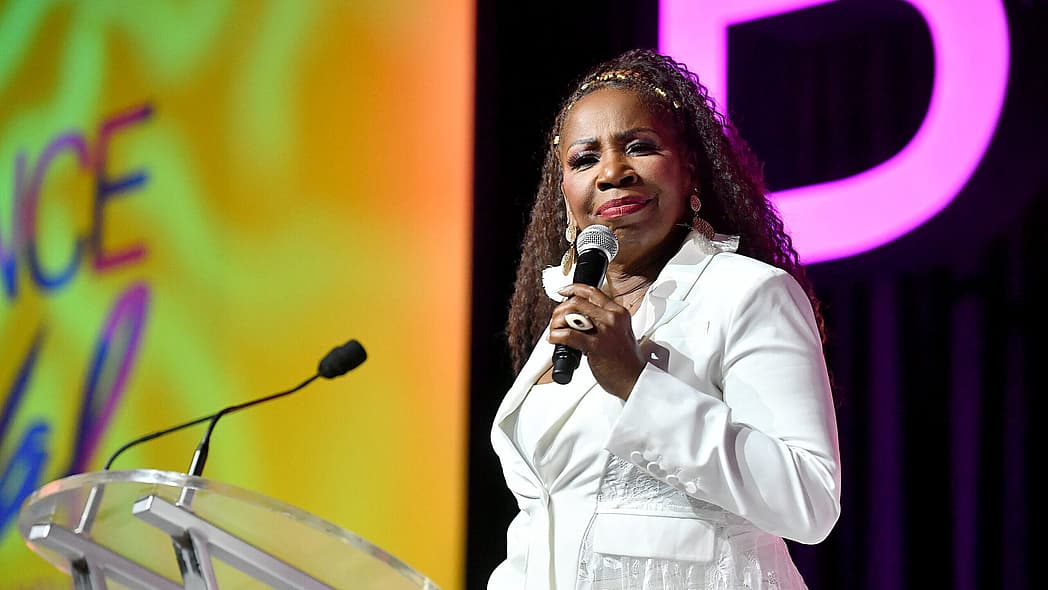
Iyanla Vanzant knows a thing or two about grief. The media icon has buried two daughters, survived an abusive relationship, and stepped away from a hit show at the height of its success. That’s why when she says more of us, in particular Black people, could use some more of it, she’s not just speaking theoretically.
During a sitdown with CNN’s Abby Phillips last week at the 30th American Black Film Festival in Miami, which theGrio sat in on, the 73-year-old spiritual leader and media personality opened up about what is keeping many of us from achieving the level of authenticity she has mastered. According to her, for a lot of us, it’s an inability to properly grieve the large and small traumas of our lives.
“The greatest gift, I think, that people can give themselves, and this is an act of spiritual hygiene, is grief,” she said while seated across from Phillips in the New World Center in South Beach.
“We have to grieve the things that we lost, we have to grieve the dreams that we never fulfilled. We have to grieve the ways of being that no longer serve who we are. We have to grieve them,” she continued. “That means sit in this thing and let yourself feel it and weep if you have to, so that you get what’s next.”
For Vanzant, grief has been a critical part of the healing process that allowed her to live more authentically following some of the greatest losses of her life. As Black Americans grapple with inherited trauma, personal tragedy, and a political climate marked by attacks on voting rights, diversity initiatives, and Black history, she argued that many have been conditioned to survive pain rather than fully process it. All of that unresolved grief, she said, may be one reason so many continue to search for the kind of leadership once embodied by figures such as Martin Luther King Jr. and Malcolm X.
“One of the things that has us so separated is our discordant energy,” she explained, noting that currently we divide ourselves and even our attention for care into categories like men, women, white, Black, gay, straight.
“How about the living people?” she said simply. “When you’re clean on the inside, everything that’s serving your vibrational frequency will come to you.”
Getting clean, Vanzant said, involves grieving. In America, many have not fully grieved the end of slavery any more than Black Americans have not fully grieved the ways its legacy continues to shape our lives. Let alone the inherited generational curses plaguing many of us. Yet many of the Black leaders, thinkers and healers who have most profoundly shaped the culture, including Vanzant, have done so by confronting that grief head-on.
“We could follow Reverend Jackson, we could follow Stokely, we could follow Reverend Dr. King, we could follow Malcolm because they were clean and they were doing what they had to do, their purpose,” she said, adding that their larger purpose doesn’t necessarily speak to the type of “humans” they were personally.
“We gotta get clear. You’ve got to do your work, you gotta clean up your mind, clean up your heart, and everything that you’re supposed to do, everything that you’re supposed to have, it’ll come to you, really,” she noted.
After a five-year hiatus from television, Vanzant returned to OWN in January with the limited series “Iyanla: The Inside Fix,” which revisited some of the most memorable cases from her hit show “Iyanla: Fix My Life,” which ended in 2021. At the time, when it wrapped, part of the reason was that Vanzant said she didn’t like the salacious direction the show was being pushed in for ratings.
“Y’all making TV, I’m healing people,” she recalled declaring at the time. “I wasn’t willing to do what was required to get the ratings by prostituting people’s pain.”
During her hiatus, Vanzant said she became clearer on her purpose and committed to doing her own healing work. The approach appears to have resonated. Following the series’ debut, OWN ordered two additional specials in February 2026, with production beginning the following month.
“You really don’t have to work that hard,” she said. “All I had to do was pick up the phone, say, “Hey, Miss O, and she said, ‘How about doing two more episodes of Fix My Life?’”
She added, “Nobody’s coming to save you, nobody’s coming to lead you, nobody’s coming to fix you, nobody’s coming to check. Do your work, and what will happen is all your posse will be drawn to you.”
