
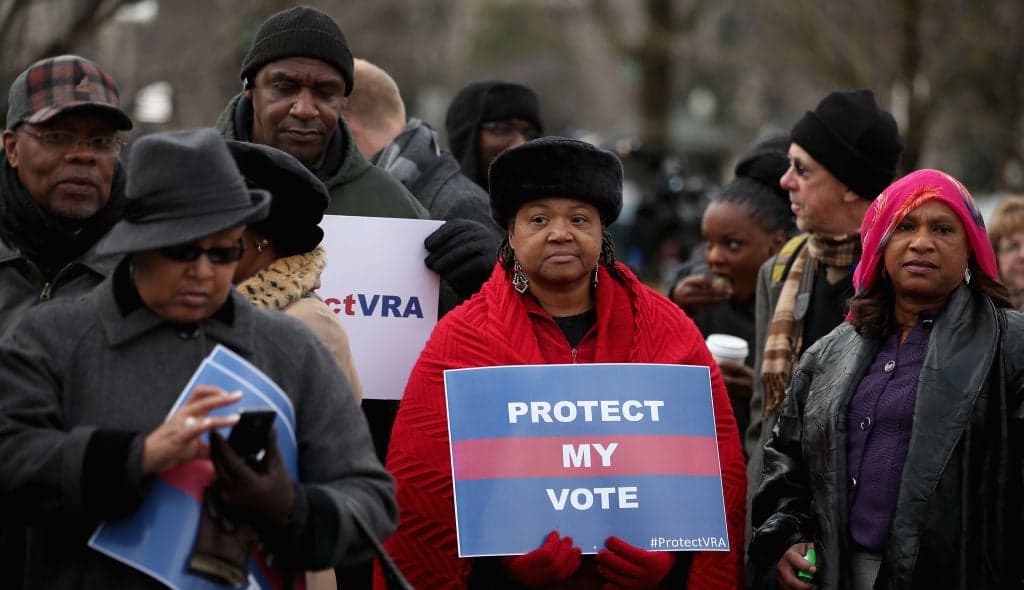
Redistricting efforts targeting largely Black districts in the South are moving rapidly, threatening the political power of Black voters at a time when they are disproportionately feeling the harms of an affordability crisis, environmental injustice, and access to health care and good-paying jobs.
On Friday, the Virginia Supreme Court dealt a major blow to Democrats’ efforts to counter Republicans’ nationwide gerrymandering strategy, led by President Donald Trump, aimed at retaining control of the U.S. House of Representatives in the 2027 session of Congress.
Despite a plurality of Virginia voters approving a new congressional map last month that gave Democrats a 10-1 advantage as a means to respond to Republicans in Texas, North Carolina, Missouri, Florida, and elsewhere, redrawing maps to give themselves huge advantages in November’s midterm elections — many at the expense of Black and brown voters — Virginia’s high court argued the process was not carried out properly under the state’s constitution.
“The Republican-led majority of the Supreme Court of Virginia contorted the plain language of the Constitution and Code of Virginia to give it a meaning that was never intended, which allowed them to reach the wrong legal conclusion that fit their political agenda. The consequences of their error are grave,” said Jay Jones, Virginia’s first Black attorney general.
Virginia’s new map was seen as a major effort to circumvent a wave of gerrymandered maps drawn by Republicans who were ordered by Trump to do so, to ensure the president could further carry out his agenda — which has included attacks on diversity and equity policies that benefited Black Americans — for the next two years.
NAACP President and CEO Derrick Johnson told theGrio that the Virginia Supreme Court’s ruling was “unfortunate,” and said the new map, which was approved by more than 1.6 million Virginians, was a needed tool to ensure “the balance of our democracy is intact.” The civil rights leader supported the map to “send a message that we have no kings,” referring to Trump.
“There shouldn’t be any edicts coming down from the White House to direct governors and other policymakers to go against the will of voters, and Virginia stood strong in saying this is not acceptable, the same way that California did in their initiative process,” said Johnson.
Many of these GOP maps come at the expense of Black leadership in Congress and the Black voters who elected them, and are made possible after last week’s Supreme Court ruling in Louisiana v. Callais gutted the Voting Rights Act of 1965, which has, for decades, protected Black voters from racial discrimination in voting. The court ruled that maps diluting the influence of Black voters were permissible under the law as long as lawmakers did so for political, not racial, reasons. In other words, Black voters would have to prove the racism they say they’re facing in voting laws is real.
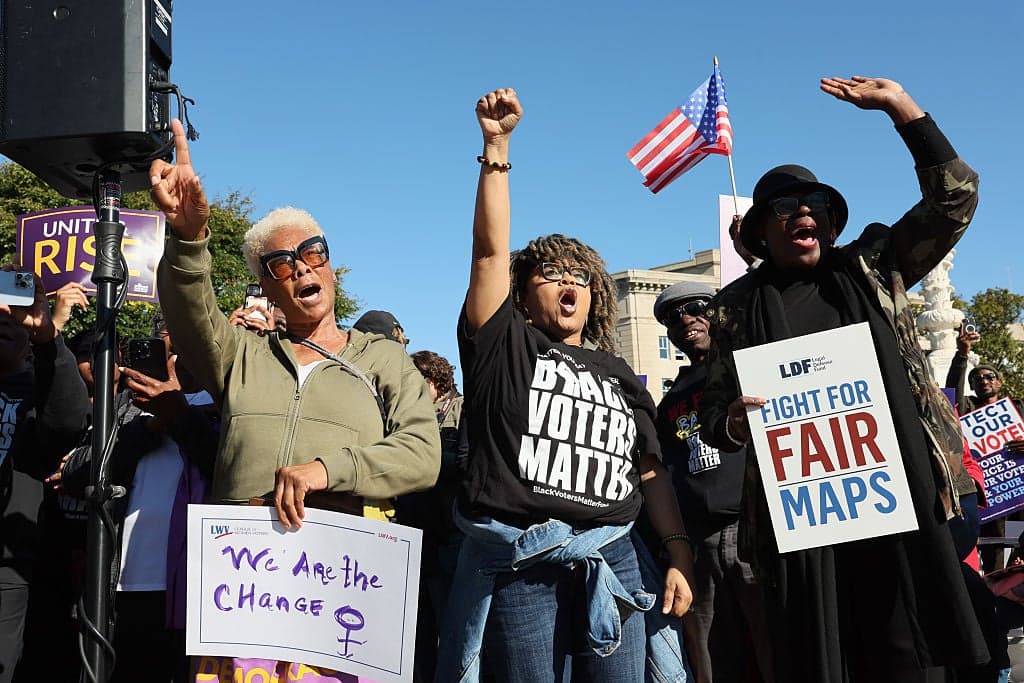
Johnson said Callais was a “bad ruling” much like infamous decisions from the 1800s by the Supreme Court that determined Black Americans were not U.S. citizens and that re-established racial segregation, telling theGrio, “It will go down in history as one of the worst rulings in the Supreme Court’s history, similar to the Dred Scott decision, or Plessy v. Ferguson.”
Meanwhile, Republicans are steamrolling maps that very clearly carve Black voters out of opportunities to influence the outcome of elections.
In Tennessee, amid hundreds of angry protesters inside and outside the state capitol, Republican lawmakers on Thursday passed a new map that eliminated the state’s only Black-majority district based in Memphis.
In South Carolina, Republicans made a step on Friday to target their own lone Black-majority district, currently represented by longtime U.S. Rep. James Clyburn, a Democrat.
In Alabama, Republicans are also moving to target at least one of the two Black-majority districts, most likely the 2nd District, held by Democrat Rep. Shomari Figures, despite the primary election being only two weeks away. The same is happening in Louisiana, where the case that gutted the VRA was launched; however, Republican lawmakers are considering eliminating both of its majority-Black districts represented by Democratic Reps. Troy Carter and Cleo Fields.
“The confederate states are for sure showing that they were never ridded of their racism,” said U.S. Rep. Jasmine Crockett, D-Texas, after the Virginia Supreme Court ruling.
Reacting to the decision, Crockett wrote on X, “when the people decide, something is inherently wrong, but when repubs ram through racist maps at the behest of an immoral incompetent immature idiot, there’s nothing to see and it’s perfectly ok.” She added, “ALL ELECTIONS MATTER… these people have cheated themselves into power & will violate any laws, constitutions, or basic rules of decency & humanity, to continue to drag our asses deeper into debt for ballrooms while people can’t afford food, gas, or healthcare!”
U.S. Rep. Hakeem Jeffries, the Democratic leader of the U.S. House, said Democrats would explore “all options” to overturn the Virginia Supreme Court’s ruling, which he called “unprecedented and undemocratic.”
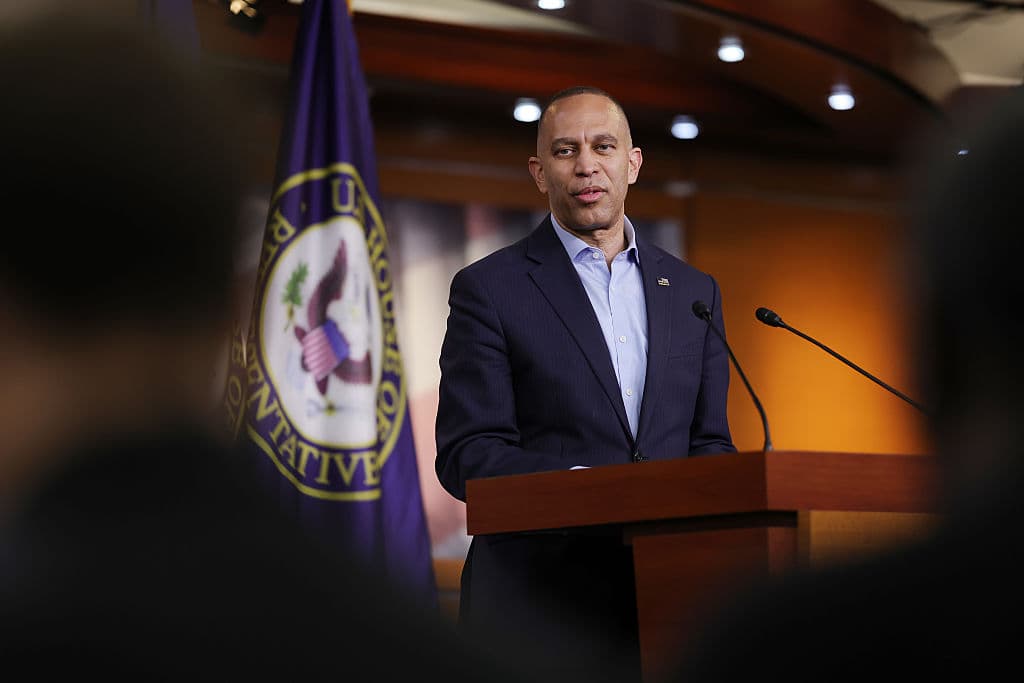
The New York congressman called out what he described as Republican “voter suppression,” which he said is further evidenced by the “far-right extremists on the Supreme Court gutting the Voting Rights Act to open the door to a Jim Crow-like attack on Black representation across the American South.”
The outcome of who controls Congress is critical for Black communities, who are facing high unemployment, a persistent racial wealth gap, and significant disparities in health care, most notably the Black maternal health crisis.
“This current administration and Congress have done more policy harm to Black Americans than we have seen in a generation or two. November is an important course corrector,” said Johnson of the NAACP.
As for the nationwide redistricting battle, the civil rights leader urged non-Black Americans to get in the fight, telling theGrio, “I don’t think the burden is for African Americans. I think the burden is for all Americans in this moment.”
Johnson continued, “We only represent 13% of the population. Americans need to ask the question, ‘What type of country will we live in?’ Will we live in a country that’s inclusive? Will we live in a country where our tax policy and our resources benefit all of the citizens and not the wealthy few?”
He added, “So that’s a question for all Americans, not just African Americans, and unfortunately, we are witnessing direct attacks on the right of many Americans to fully engage and participate as guaranteed under our Constitution.”
